Wanderroute lays out what the dispute over open-net salmon farms on Canada's west coast is actually about – wild salmon migration routes, the scientific debate over fish viruses, and the differing perspectives of conservationists, industry, and coastal First Nations. This site deliberately takes no position of its own.
Jump to the logbook ↓Background information, independent of any single campaign, in roughly the order these questions tend to come up.
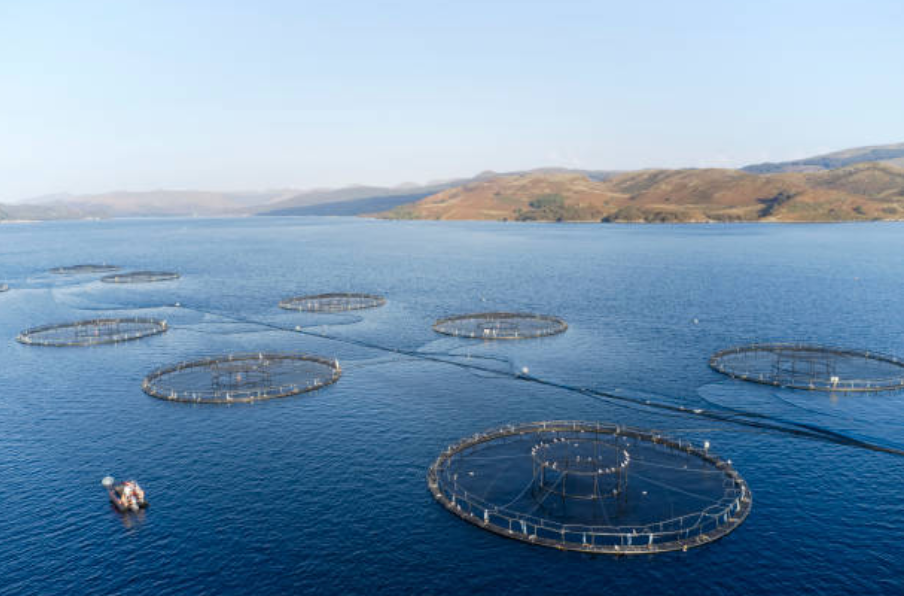
Open-net salmon farms raise farmed salmon in open cages directly in the ocean, often along natural wild salmon migration routes. Water exchanges freely with the surrounding environment, which makes feeding and maintenance simpler but also allows direct contact between farmed and wild fish populations – a central point of contention in the broader debate.
Fraser River sockeye salmon migrate from spawning grounds inland in British Columbia through coastal waters near Vancouver, along the eastern shoreline of Vancouver Island, toward Port Hardy, and out into the open Pacific. Large stretches of this route run past numerous salmon farms, which is part of why this particular region has become a natural starting point for research and monitoring.
Piscine reovirus (PRV) is a fish virus whose significance for wild salmon health remains unsettled among scientists. Some studies link PRV to an inflammatory heart condition in farmed fish; exactly how much the virus affects wild populations is assessed differently across the scientific literature. Infection-rate figures usually come from individual studies or campaigns and are worth checking against the original source before being repeated as settled fact.
For many First Nations communities on the BC coast, wild salmon has been culturally, economically, and nutritionally central for generations. Several nations along affected migration routes have publicly called for relocating or removing net-pen farms; other communities hold economic stakes in aquaculture operations themselves. The position among coastal First Nations is therefore not uniform.
For anyone wanting to make informed choices independent of the broader scientific dispute, sourcing labels and independent sustainability certifications for seafood are a practical starting point. These certifications differ in criteria and rigor, so looking at how a given label is actually awarded tends to be more informative than the logo alone.

Both sides presented in their own terms, with no weighting applied by this site.
A Canadian federal court rules that PRV-positive farmed salmon cannot be transferred into open-net marine pens without ministerial approval.
A months-long research and monitoring voyage along the Fraser River sockeye's migration route is carried out by a biologist alongside an international marine conservation organization – cited here as a concrete, real-world example of this kind of field research.
Petitions and policy initiatives around regulating or phasing out open-net licenses on the BC coast continue to be debated; the current policy status changes, so check against an up-to-date source before publishing anything as current fact.
Wanderroute has no affiliation with the voyage, its organizers, or the organization involved as described above; it is cited purely as a real, documented example.
Few environmental issues on Canada's west coast are debated as intensely as open-net salmon farms – and few get reduced so often to a single, supposedly "correct" position. In practice, it's a layered debate with legitimate points on more than one side.
"Do salmon farms cause wild salmon declines?" is hard to answer scientifically with a clean yes or no, because wild salmon populations are shaped by a range of factors – ocean temperature, overfishing, habitat loss in rivers, and possibly disease transmission from fish farms as well. Individual studies typically isolate just one of these factors, which makes it difficult to draw a single, clear causal conclusion for the picture as a whole.
Statistics like "a given percentage of farms are infected" usually come from individual, often campaign-driven studies with a specific methodology and sample size. That doesn't automatically make them wrong, but it's worth checking the original study and its methodology before repeating the figure independent of that context.
Aquaculture operators reasonably point out that they operate under monitoring and regulatory requirements that have tightened considerably since the industry's early years. Many coastal regions are also economically dependent on aquaculture jobs – a dimension that purely environment-focused debates sometimes underweight.
It would be an oversimplification to speak of a single First Nations position on this issue. Some nations are vocally calling for an end to open-net practices on their traditional territory; others hold economic stakes in aquaculture projects themselves or have their own agreements with operators. Both are legitimate, independent positions within the same debate.
This piece summarizes publicly available positions and deliberately takes no position of its own on the underlying scientific or policy question. For current, reliable data, going directly to primary sources and regulatory reports is recommended.
A look at the biology behind one of North America's best-known animal migrations.
Read moreWhat criteria actually sit behind the most common certifications.
Read moreA closer look at the range of positions held along the coast.
Read more